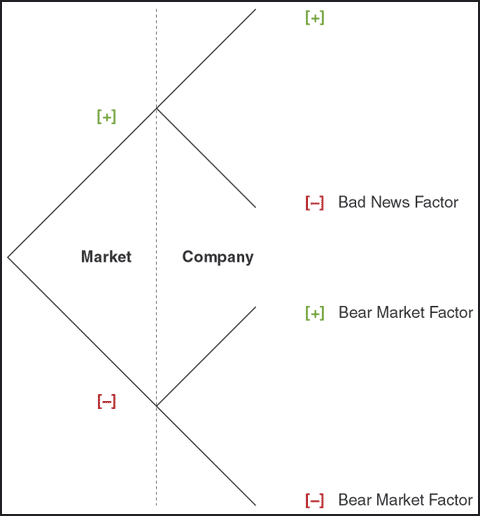
To determine the "Bad News Factor" we analyze a stock's declines in rising markets. In this purely
objective analysis, the actual reasons for a stock's behavior are not important. If a stock
price falls while its relative index goes up, it can be assumed that the stock's performance
has been affected by bad news - hence the name, "Bad News Factor".
How to interpret the "Bad News Factor":
Simply take the percentage difference (in basis points) between the rise of the index and the
decline of the stock. For example, if a stock drops 2%, while during the same time period its
reference index goes up 1%, the percentage difference is 3, or 300 basis points. Therefore,
our "Bad News Factor" will be 300.
In bi-weekly intervals that correspond to our updates, we track a stock's movement over the
course of a standard sliding 52-week period. Each time the stock goes down while its reference
index goes up, the percentage difference is calculated, absorbed into the yearly average and
expressed in basis points as the "Bad News Factor".
For example, the number 114 would mean that during the last 12 months, each time UBS went down
when the SMI went up, the average of the differences measured between the respective
performances was 1.14%.
Things to remember:
 |
The higher the "Bad News Factor", the more a stock is sensitive to bad news.
|
|
The smaller the "Bad News Factor", the less the stock is sensitive to bad news. |