Our Valuation Rating indicates if a stock is selling at a relative premium or bargain price, based on its growth potential.
To estimate a stock's value relative to its current price our Valuation Rating combines:
 | stock price; |
| projected earnings; |
| projected earnings growth; |
| dividends. |
By combining these elements we can establish a rating for the analyzed company.
There are five ratings, ranging from strongly undervalued [ ] to strongly overvalued [
 ] (see below).
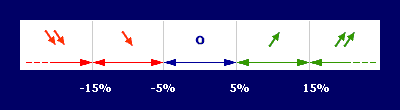
theScreener.com Valuation Rating
(difference between projected value and current price)
When we analyze a company's projected long-term earnings growth, we place a certain emphasis on the G/PE
Ratio. While the first two elements in our analysis are important, and fairly simple to understand (stock price and current earnings), the G/PE
Ratio merits further explanation.
Some analysts watch the PE (Price Earnings ratio) - the ratio of stock price divided by earnings per share. In general, this ratio is fairly linear: a low PE suggests an inexpensive/low-risk stock, while a high PE suggests an expensive/high-risk stock.
In our model, the concepts of expensive/inexpensive do not depend on the PE, but on the relation between the PE and growth. Multifactor analysis has showed that the estimated growth of earnings provides the best base for the evaluation of a stock. There is approximately a 60% correlation of estimated earnings growth to stock value.
Our G/PE
Ratio measure quickly evaluates a company and detects firms that offer the greatest relative potential for the future and are therefore, the most undervalued. Correspondingly, our G/PE
Ratio also detects firms that offer the least relative potential for the future and are thus, the most overvalued. Our G/PE
Ratio measure conveniently compares two stocks at a glance. Our growth projections are always based on an average of at least three estimates.
The moment an investor buys a stock, the stock's present situation becomes the past, and the success of the investment depends fully on the future. theScreener.com takes into consideration the current earnings situation for a company but focuses on the future in order to establish a true Valuation Rating.


